With Japan’s ongoing labor shortage, many companies are now considering the option of hiring foreign workers.
However, employing foreign nationals comes with unique challenges — such as language and cultural differences, visa management, and compliance with labor laws and immigration regulations.
If these issues are not properly addressed before hiring, companies risk workplace conflicts, administrative warnings, or in the worst cases, penalties for promoting illegal employment.
In this column, we’ll take a close look at the main challenges companies face when hiring foreign workers, along with practical countermeasures, real-life success stories, and key legal points that every employer should understand.
Our explanations are based on insights from labor and social security attorneys specializing in foreign employment, ensuring clarity and reliability for HR professionals and business owners alike.
まずはお気軽に無料相談・
お問い合わせください!
1. The Current Situation of Foreign Employment in Japan
With Japan’s ongoing labor shortage, hiring foreign workers has become an increasingly realistic option for many companies.
In this chapter, we’ll take a closer look at the current labor environment companies are facing and the background behind this trend.
1-1. Japan’s Ongoing Labor Shortage
Japan’s population is aging rapidly, and the number of people of working age (15–64) continues to decline.
This has led to a chronic shortage of workers, especially among small and medium-sized enterprises and in regional areas.
Under these circumstances, even companies that were once hesitant to hire foreign workers are now being pushed to take a more proactive approach to secure the human resources they need.
Trends in the Number of Foreign Residents in Japan (as of the End of 2024)
- Total number of foreign residents: 3,768,977
(An increase of 427,985 from the previous year — up 12.8%) - Mid- to long-term residents: 3,494,954
- Special permanent residents: 274,023
Number of Foreign Residents by Nationality or Region (as of the end of 2024)
- China — 844,187
- Vietnam — 600,348
- South Korea — 411,043
- Philippines — 332,293
- Brazil — 212,325
- Nepal — 206,898
- Indonesia — 173,813
- Myanmar — 110,306
- Taiwan — 67,277
- United States — 64,842
Number of Foreign Residents by Visa Type (as of the end of 2024)
- Permanent Resident — 902,203
- Technical Intern Training — 425,714
- Engineer / Specialist in Humanities / International Services — 394,295
- Student — 368,589
- Dependent — 283,204
Source: Immigration Services Agency of Japan, “Number of foreign residents as of the end of 2024”
1-2. Trends in the Number of Foreign Workers
In recent years, Japan has made significant progress in improving the legal framework for employing foreign workers — including the introduction of the Specified Skilled Worker system and revisions to the Technical Intern Training program. These reforms have helped create a more structured environment for foreign nationals to work in Japan.
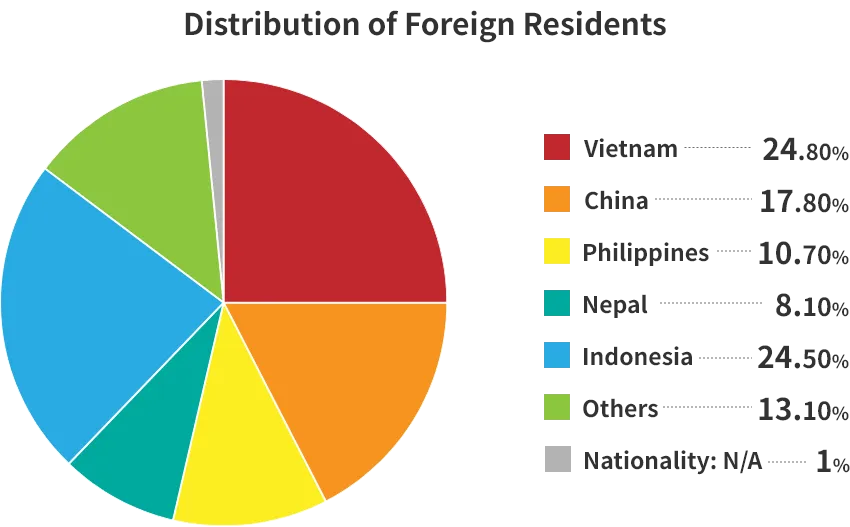
Latest Statistics (as of the end of October 2024)
- Number of foreign workers: 2,048,675 (+225,950 from the previous year, +12.4%)
This marks the highest number since statistics began in 2007. - Number of workplaces employing foreign workers: 318,775 (+19,985 from the previous year, +6.7%)

Top 5 Countries by Nationality (Number of people)
- Vietnam — 518,364
- China — 397,918
- Philippines — 206,050
- Nepal — 145,617
- Indonesia — 121,328
Breakdown by Visa Type (Number of people)
- Specialist / Technical Fields:
572,804 (+11.6% from the previous year)
E.g.: Engineer / Specialist in Humanities / International Services, Highly Skilled Professional, etc. - Technical Intern Training:
404,316 (−3.6% from the previous year)
Currently showing a downward trend as discussions on reforming the program continue. - Specified Skilled Worker:
208,556 (+62.3% from the previous year)
Remarkably rapid growth only a few years after the system was introduced. - Status Based on Personal Relationship:
582,604 (+3.8% from the previous year)
E.g.: Permanent Resident, Spouse or Child of a Japanese National, Long-Term Resident, etc.
Sources: Immigration Services Agency of Japan — “Number of foreign residents as of the end of 2024”
Ministry of Health, Labour and Welfare — “Summary of the Notification Status of Foreign Worker Employment (as of the end of October 2024)”
The driving force behind the recent growth in foreign employment is the Specified Skilled Worker system.
This program was designed to secure immediately employable workers with practical skills, and it has been rapidly adopted in labor-short industries such as construction, food service, and nursing care.
1-3. Laws Governing the Employment of Foreign Nationals
When hiring foreign workers, companies must take into account legal and procedural requirements that differ from those for Japanese employees.
This includes verifying residence status, submitting various notifications, and managing compliance under multiple laws and regulations.
If internal systems are inadequate or if the company misunderstands the rules, it may become subject to administrative action or penalties.
Let’s look at the key legal frameworks that employers should be aware of.
Main Laws and Systems Related to Foreign Employment
Immigration Control and Refugee Recognition Act (Immigration Act)
This law sets the rules for the entry, stay, and departure of foreign nationals.
Employers must ensure proper management based on this law — including confirming that the worker holds the appropriate visa status, that their actual work matches the permitted activities, and that their period of stay is properly managed.
The law also defines the crime of promoting illegal employment, which applies when an employer allows a foreign worker to work unlawfully.
Labor Standards Act
This law establishes the minimum standards for working conditions, such as working hours, rest periods, holidays, wages, and dismissal.
All workers — regardless of nationality — are protected under this act. Companies that violate these rules (for example, through excessive overtime or unpaid wages) may face legal penalties.
Minimum Wage Act
This law prohibits employers from paying wages below the minimum wage set by each prefecture.
It applies to all workers in Japan, regardless of nationality or visa status. Paying less than the minimum wage is a clear violation of the law and can lead to fines or other sanctions.
Employment Security Act / Employment Measures Act
These laws are designed to ensure fair employment practices and stability in the labor market.
When hiring foreign nationals, employers are required to report information such as the employee’s name, visa type, and employment status to the Ministry of Health, Labour and Welfare. Failure to file this report may result in administrative guidance or corrective instructions from the authorities.
1-4. Common Challenges and Workplace Issues
The challenges companies face when hiring foreign workers are not limited to paperwork or legal procedures.
Many of the actual problems that occur on-site are caused by communication barriers or cultural differences, making it essential for companies to improve both their internal systems and mindset toward diversity.
Common Workplace Challenges and Trouble Cases
Mistakes and Accidents Caused by Language Barriers
- Misunderstanding of work instructions leading to operational errors or safety incidents
- Delays in reporting or seeking help, causing problems to escalate
Cultural and Value Differences
- Differences in time perception or workplace communication styles (such as how reporting and consulting are handled) leading to conflicts among staff
- Misunderstandings or tension arising from differing attitudes toward supervisors and senior colleagues, or differences in values between men and women
Discrimination and Unconscious Exclusion
- Assigning certain tasks or excluding workers from meetings or company events simply because they are foreign nationals, resulting in frustration or isolation
- Careless comments or jokes on SNS being perceived as discriminatory, leading to workplace issues
Inadequate Working Conditions
- Labor disputes arising because the employment contract was written only in Japanese, and the foreign worker did not fully understand its contents
- Cases where unpaid overtime or excessive working hours led employees to file complaints with the Labor Standards Inspection Office or the Labor Bureau
Mismatch Between Visa Status and Job Description
- Instances where a worker hired under the Engineer / Specialist in Humanities / International Services visa was assigned manual labor tasks (such as inspection or cleaning) that are not permitted under that visa category — resulting in penalties for both employer and employee
- Cases where individuals holding visas such as Student or Dependent (which generally do not allow full-time work) were employed without proper authorization, leading to violations of the Immigration Control Act
To ensure the successful employment of foreign workers, companies must not only comply with laws and regulations but also foster a corporate culture that embraces diversity.
Equally important is the establishment of clear training, supervision, and management systems at the operational level.
2. Key Issues and Practical Solutions in Hiring Foreign Workers
In this chapter, we’ll explore the main challenges that arise in foreign employment—from recruitment and visa management to working conditions, communication, daily life support, and retention—and explain the practical solutions from the perspective of labor and social security experts.
2-1. Recruitment: Effective Job Posting and Interview Practices
The first step in hiring foreign workers is to find candidates who are a good fit for your company.
A mismatch at the recruitment stage can lead to early resignations or workplace conflicts, so careful preparation is essential.
Key Points for Hiring Foreign Workers
1. Clearly define the ideal candidate, required skills, and Japanese language proficiency.
- When posting job openings, consider using multilingual job platforms to reach a wider pool of applicants.
- Include clear information in the job listing—such as job duties, salary, visa support availability, and language requirements—so candidates can apply with confidence.
2. During interviews, check not only their background but also the following:
- Japanese language ability
- Cross-cultural adaptability (how well they can accept and adjust to different cultures)
- Willingness to work long-term
3. Additional Tips
- Provide materials in the applicant’s native language or use simple Japanese to help them feel relaxed and show their true abilities.
- To prevent misunderstandings, explain working conditions and benefits in multiple languages, and make sure the candidate fully understands before finalizing the hire.
2-2. Visa Management: Types and Points to Watch
When hiring foreign workers, it is essential to confirm that they hold the appropriate residence status (visa) and to follow the correct legal procedures.
Below are some of the main visa types that allow employment in Japan.
Key Work-Related Visa Categories
1. Engineer / Specialist in Humanities / International Services Visa
This is one of the most common work visas for professional and office-based roles such as administration, planning, and engineering.
It allows foreign workers with knowledge in natural sciences or humanities to engage in specialized work that makes use of their expertise or international perspective.
Most white-collar positions fall under this category.
e.g.: Engineers (system engineers, mechanical design, R&D, etc.), Office professionals (planning, marketing, accounting, general affairs), Interpreters and translators, language instructors, trade specialists, designers, and more.
2. Specified Skilled Worker Visa
This visa category allows foreign nationals with practical skills to work in 16 designated industries facing severe labor shortages, such as construction, nursing care, and agriculture.
Applicants must pass both a skills test and a Japanese language proficiency test, and this visa enables employment in sectors that were previously not open to foreign workers.
e.g.: Nursing care, construction, food service, manufacturing, accommodation Industry, and building cleaning.
3. Skilled Labor Visa
This visa is for individuals engaged in traditional or highly specialized occupations that require “advanced technical skills”.
It is intended for craftsmen and specialists who possess unique techniques or cultural expertise, where experience and professional achievement are valued more than academic background.
e.g.: Chefs of ethnic cuisines (such as Chinese cuisine), jewelry or precious metal artisans, furniture craftsmen, pilots, animal trainers, sommeliers, sports instructors, and traditional construction specialists.
4. Highly Skilled Professional Visa
This is a points-based visa designed to attract foreign professionals with advanced expertise who are expected to contribute to Japan’s economy and society.
It offers various benefits, such as a shortened path to permanent residency and work authorization for spouses.
e.g.: Researchers or university professors holding doctoral degrees, high-income IT engineers or managers, professionals with extensive project management experience, and startup founders or business executives who achieve high point scores.
5. Intra-Company Transferee Visa
This visa allows companies to temporarily transfer employees from an overseas parent company, subsidiary, or affiliate to a branch office in Japan.
The job duties are similar to those under the Engineer / Specialist in Humanities / International Services visa, but the applicant must have prior work experience at the overseas office.
e.g.: Employees transferred from an overseas branch to the Japanese headquarters, or staff relocated from a foreign parent company to a Japanese subsidiary.
Important Points to Note
- The type of visa determines what kind of work a foreign employee can engage in and the requirements for renewal, which vary significantly by category.
- If the actual job duties do not match the authorized visa type, the company may be charged with promoting illegal employment under the Immigration Control Act.
- Since visa-related procedures can be complex and time-consuming, it is advisable to consult a certified immigration specialist or other qualified professional.
- Establish an internal HR management system to track visa validity periods, renewal schedules, and work restrictions in a centralized manner.
Foreign employees themselves may not always be familiar with the legal details of the visa system.
Therefore, it is essential for company representatives and HR personnel to regularly update their knowledge and continue providing accurate and supportive guidance to ensure compliance.
2-3. Working Conditions: Compliance with the Labor Standards Act
Japan’s labor laws apply equally to foreign and Japanese workers.
By clarifying employment conditions and ensuring compliance with legal standards, companies can prevent disputes and create a safe, trustworthy work environment for foreign employees.
Common Issues
- Paying foreign employees lower wages than Japanese workers in similar positions
- Improper working conditions, such as excessive overtime or unpaid wages
- Lack of social insurance coverage or insufficient employee benefits
- Workers not fully understanding their employment terms due to language barriers
Key Measures for Compliance
Clarify Wages and Benefits
Ensure that wages meet at least the legal minimum wage and that foreign employees receive equal treatment as Japanese staff.
Always pay proper overtime, late-night, and holiday allowances.
Proper Work Hour Management
Follow the legal limits of 40 hours per week and 8 hours per day, providing appropriate rest periods and days off as required by law.
Use time cards or digital systems to accurately record working hours.
Apply Social Insurance Coverage
If the employment conditions meet eligibility requirements, employees must be enrolled in health insurance, pension, employment insurance, and workers’ compensation insurance.
Provide Employment Contracts and Notifications in Multiple Languages
If a worker is not confident in Japanese, offer translated versions or use simple Japanese to ensure full understanding of the terms.
Explain Workplace Rules and Employee Rights Clearly
Since many foreign workers may not be familiar with Japanese labor laws, it’s important to provide detailed explanations of rights and company policies during orientation or one-on-one meetings.
2-4. Communication: Language Education and Cross-Cultural Understanding
Smooth communication with foreign employees directly affects not only work efficiency but also employee retention and overall workplace atmosphere.
To prevent mistakes or misunderstandings caused by language barriers or cultural differences, companies need to take proactive measures.
Common Challenges
- Frequent work errors or accidents due to language barriers
- Miscommunication caused by differences in business manners or workplace culture (such as reporting and consultation practices)
- Feelings of isolation among foreign employees, leading to poor retention rates
Key Measures
Support for Japanese Language Learning
Depending on the level of language skills required for the job, consider the following support measures:
- Partnering with or recommending external Japanese language schools
- Providing casual in-house conversation sessions or simple learning materials
- Encouraging online study during commuting or off-hours
Cross-Cultural Training
Organize training sessions that introduce Japanese business customs and daily life culture to help reduce friction and misunderstandings.
It is also effective to educate Japanese staff about foreign cultures and values to promote mutual understanding.
Use of Translation and Interpretation Tools
Incorporate translation apps, multilingual internal chat systems, or bulletin board tools into daily operations to ensure smoother communication.
Regular One-on-One Meetings
Hold regular one-on-one meetings that consider language and cultural differences, providing opportunities for employees to discuss work or personal concerns.
This helps build trusting relationships and reduces the risk of turnover.
2-5. Daily Life Support: Support for Daily life and Consultation Systems
For foreign workers to feel secure living and working in Japan, stability in daily life is just as important as workplace environment.
If adequate housing and community assistance are not provided, workers may feel isolated in an unfamiliar environment, leading to stress and even early resignation.
Common Challenges
- Unable to find or rent housing due to lack of a guarantor or restrictions against foreign tenants
- Unfamiliarity with Japanese daily customs such as garbage disposal or hospital visits
- No place to ask for help or seek advice when problems arise
Key Measures
Housing Support
- Provide company housing or assistance with rental contracts
- Introduce reliable guarantor companies or collaborate with real estate agencies
- Offer multilingual explanations of contracts and important notes upon moving in
Life Orientation Programs
- Explain local rules such as garbage sorting and how to use public transportation
- Provide information on how to find hospitals and emergency contacts
- Create manuals for disaster preparedness and administrative procedures
- Use videos or illustrations to make explanations easier to understand
Establish Consultation Services
- Assign a dedicated staff member in charge of supporting foreign employees
- Collaborate with multilingual NPOs or professionals such as immigration specialists and lawyers
- Provide anonymous consultation options through online forms or LINE chat
When companies have a solid system to support daily life, foreign employees feel safer and more satisfied, which helps improve retention and motivation.
Post-hiring life support should be considered an important part of HR strategy, not an afterthought.
2-6. Retention: Career Development. Education and Evaluation Systems
Even if you successfully hire foreign employees, it means little if they leave after a short time.
To help them grow and stay long-term, post-hiring retention support is essential.
Let’s look at some key points for building a workplace where foreign employees can thrive.
Common Challenges
- Many foreign workers feel uncertain because their career path is not clearly defined
- Some foreign employees feel isolated, with no one at work they can easily talk to
- Employees feel dissatisfied or unconvinced by performance evaluations
Key Measures
Clarify Career Paths
- Clearly present the promotion and salary increase system, as well as the steps required for skill development
- Offer qualification support programs and in-house training opportunities to boost motivation
Introduce a Mentorship System
- Assign an experienced employee to support each new hire during the initial stage of employment
- Encourage mentors to provide not only work-related advice but also personal and lifestyle support
Establish a Fair Evaluation System
- Create evaluation standards that balance performance, behavior, and attitude
- Provide regular feedback on evaluation results to help employees understand and feel confident in the process
To build a workplace where foreign employees feel, “I want to work here for a long time,” companies must not only develop solid systems but also listen carefully to voices from the workplace.
3. Case Studies: Successes and Lessons from Failures
In this section, we’ll introduce examples of both successful and unsuccessful cases of foreign employment across different industries, along with the measures taken afterward.
Let’s review each case while identifying key takeaways for success.
3-1. E.g. of Successful Foreign Employment
Success Case ①: Manufacturing Company A – “Strong Retention Support and Deep Cultural Understanding”
Challenge
Wanted to solve a chronic labor shortage
Approach
- Hired Specified Skilled Workers and provided Japanese language and lifestyle support even before they joined the company
- Created manuals in employees’ native languages and held regular one-on-one meetings
- Introduced an employee recognition system and multicultural social gatherings to encourage cross-national communication
Result
Employees adapted quickly to the workplace, turnover rates decreased, and both technical standardization and teamwork improved
Key Point
The company viewed foreign workers not just as “labor,” but as valuable human resources contributing to the organization
Success Case ②: IT Company B – “Diversity as a Source of Competitiveness”
Challenge
Needed to secure highly skilled global talent
Approach
- Hired highly skilled foreign engineers under the Highly Skilled Professional visa and adopted English as the company’s common language
- Introduced remote work and flextime systems to promote flexible work styles
- Assign personnel from target countries to customer support in local markets,, directly supporting business expansion
Result
Improved project success rates and contributed to the growth of overseas operations
Key Point
The company positioned foreign recruitment as “a core part of its business strategy”, creating an environment where diverse talent can truly thrive
Success Case ③: Nursing Care Facility C – “Supporting Qualifications and Career Development”
Challenge
Faced a shortage of personnel in the nursing care field
Approach
Accepted Specified Skilled Workers and conducted regular training sessions on Japanese language and caregiving techniques
Supported employees in obtaining national certifications and presented clear career paths
Result
Employee motivation increased, long-term retention improved, and service quality became more consistent
Key Point
Focused not merely on securing labor but on “developing and nurturing talent” for the long term
3-2. Failure Cases and How to Avoid Them
Case ①: Construction Company D – “Lack of Preparation Leading to Early Turnover”
Issues
- No follow-up support after hiring, causing confusion on-site as foreign workers could not fully understand Japanese instructions
- No regular meetings or feedback opportunities, resulting in growing dissatisfaction
Result
More than half of the foreign workers resigned within one year
Lesson
The importance of establishing a solid support system before and after hiring, along with continuous communication and feedback
Case ②: Restaurant Company E – “Chronic Legal Violations Threatening Business Survival”
Issues
- Payment below minimum wage and excessive overtime work
- Lack of understanding and disregard for the Labor Standards Act and Immigration Control Act
Result
Worker complaints spread widely on SNS, severely damaging the company’s reputation
Lesson
A corporate culture that neglects compliance will ultimately destroy the company’s credibility and very reason for existence
Case ③: Retail Company F – “Cultural Neglect Leading to Workplace Division”
Issues
Assigned foreign employees to the workplace without sufficient training, resulting in friction with Japanese staff
Allowed An atmosphere that fostered prejudice against foreign workers to persist.
Result
Employee morale declined, and interpersonal relationships deteriorated
Lesson
Lack of understanding and respect for multicultural coexistence weakens organizational strength and unity
In summary, successful companies tend to have a well-prepared and structured approach to hiring and supporting foreign employees.
They emphasize workplace environments built on cultural understanding, as well as clear career development opportunities and fair evaluation systems.
On the other hand, companies that failed often shared common traits such as a lack of support systems, disregard for legal compliance, and a tendency to see foreign workers merely as a source of labor rather than as valuable individuals.
Ultimately, the success or failure of foreign employment depends not only on how well a company utilizes existing systems, but also on its “willingness to understand and respect people as human beings”.
4. Professional Support for Foreign Employment
To avoid failure in hiring and managing foreign workers, it is essential not only to make improvements based on accurate information but also to seek support from professionals.
Because the laws and systems related to foreign employment are complex and frequently revised, it is risky to make decisions solely within the company.
Consulting with specialists can help ensure compliance and smooth operations.
4-1. How Experts Can Help
Since the challenges of foreign employment are wide-ranging, companies should utilize expertise from specialists in each field as shown below.
Labor and Social Security Attorney (Sharoushi)
- Handles all procedures related to labor and social insurance
- Prepares and updates employment rules tailored for foreign workers
- Proposes and assists with subsidy applications
Sharoushi are particularly helpful when setting up internal systems and supporting long-term employee retention.
Administrative Scrivener (Gyoseishoshi)
- Applies for, renews, or changes residence status on behalf of clients
- Provides advice on compliance with the Immigration Control Act
- Prepares documents related to life support for foreign residents
Administrative scriveners are legally authorized to handle visa-related matters, including work visas and Specified Skilled Worker procedures.
Lawyer (Bengoshi)
- Reviews labor contracts and employment regulations for legal compliance
- Handles labor disputes and lawsuits
- Advises on protecting the rights of foreign workers
Lawyers are often consulted when serious disputes arise, such as dismissals, harassment, or legal violations involving foreign employees.
By clearly understanding the roles of each professional and working together when necessary, companies can achieve safer and more efficient foreign employment management.
At Daiichi Sogo Group, we have labor and social security attorneys (Sharoushi) and administrative scriveners (Gyoseishoshi) who specialize in international employment matters.
Depending on the case, we also collaborate with other legal and professional experts to provide comprehensive support.
Please feel free to contact us for consultation or assistance tailored to your company’s needs.
5. Conclusion
In this column, we have explored the current state of foreign employment in Japan—covering the challenges companies face, effective countermeasures, success and failure case studies, and how to make use of professional support.
As Japan continues to struggle with an aging population and a shrinking workforce, hiring foreign workers has become an essential option for many companies.
However, it is not enough to view them merely as “labor.” To build a truly sustainable and successful workplace, companies must recognize and respect each individual as “a valued member of the team”.
Successful companies share a common mindset: they go beyond systems and procedures to cultivate an organizational culture that “grows together with foreign employees”.
We hope this column serves as a helpful guide for your company in developing effective and human-centered strategies for foreign employment.
この記事の監修者

社会保険労務士法人第一綜合事務所
社会保険労務士 菅澤 賛
- 全国社会保険労務士会連合会(登録番号13250145)
- 東京都社会保険労務士会(登録番号1332119)
東京オフィス所属。これまで800社以上の中小企業に対し、業種・規模を問わず労務相談や助成金相談の実績がある。就業規則、賃金設計、固定残業制度の導入支援など幅広く支援し、企業の実務に即したアドバイスを信念とする。