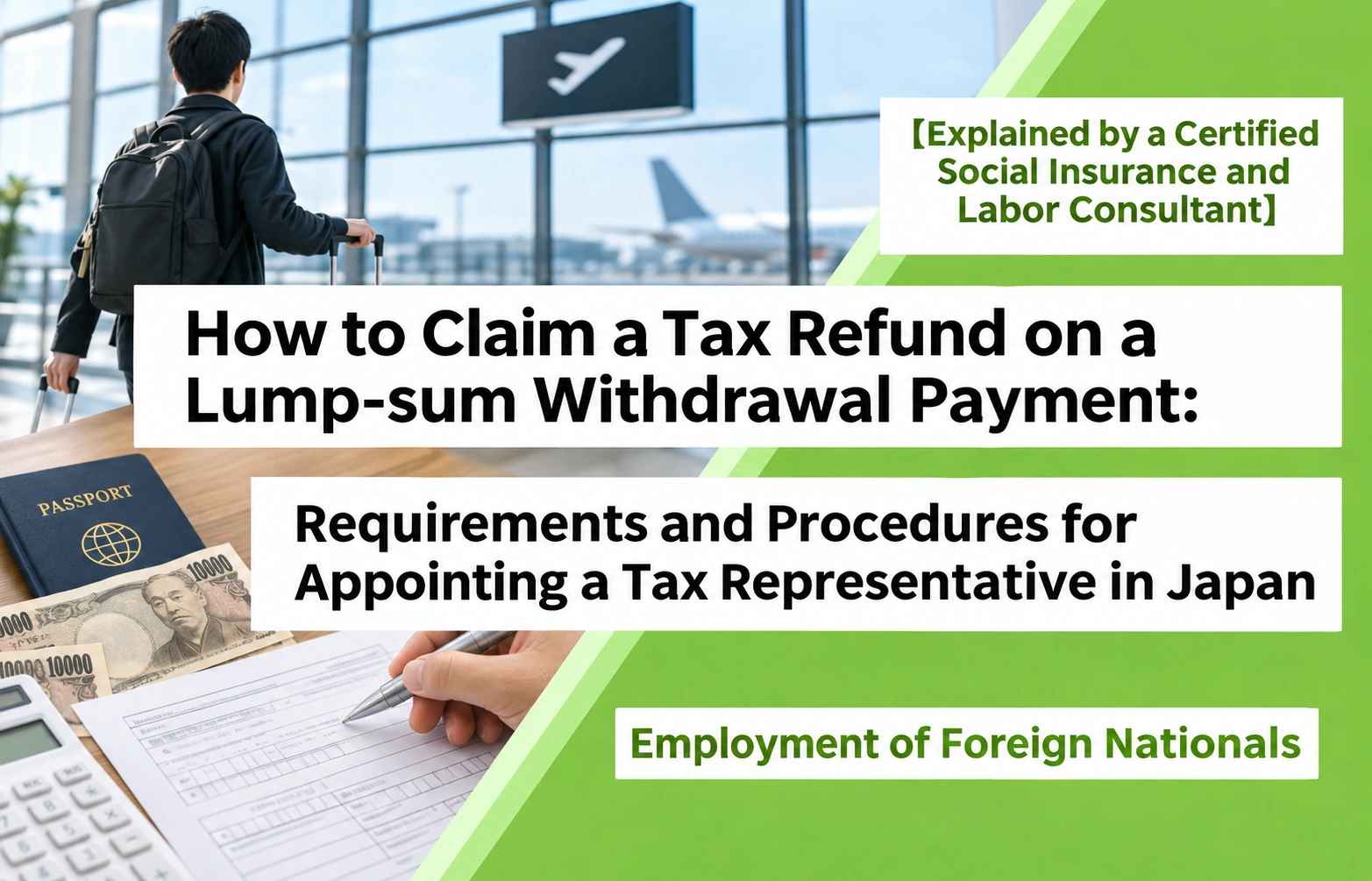
For foreign workers who have worked in Japan and are planning to return to their home countries, or who have already left Japan, the Lump-sum Withdrawal Payment system may be an important source of funds after departure. The system allows eligible individuals to claim a lump-sum payment under Japan’s public pension system.
However, when a Lump-sum Withdrawal Payment is made under Employees’ Pension Insurance, income tax and the Special Income Tax for Reconstruction are withheld at a rate of 20.42% of the payment amount. As a result, the amount received may be lower than expected. Many people give up, thinking, “Even though it is pension money I earned and paid by working in Japan, a large amount is deducted as tax.”
In this column, from the perspective of a Certified Social Insurance and Labor Consultant (社労士, Sharōshi) handling international affairs, we explain to foreign workers themselves the tax mechanism imposed on the Lump-Sum Withdrawal Payment, how to file a tax return to claim a refund to legally retrieve it, and the legally required “Tax Agent” (納税管理人, Nōzei Kanriin). Depending on the individual’s circumstances and the applicable tax calculation, filing the appropriate tax return may allow some or all of the tax withheld to be refunded. This article explains the process and the key points to consider.
まずはお気軽に無料相談・
お問い合わせください!
1. Overview of the Lump-sum Withdrawal Payment System and Eligibility Requirements
The Lump-sum Withdrawal Payment system allows eligible non-Japanese nationals who leave Japan after short periods of pension coverage to claim a lump-sum payment under Japan’s public pension system. Eligibility depends on meeting all applicable requirements.
To claim the Lump-Sum Withdrawal Payment, you must meet all of the following requirements:
- You do not possess Japanese nationality.
- You must have at least six months of qualifying coverage under the National Pension or Employees’ Pension Insurance system.
- You do not have an address in Japan (a notification of moving abroad must have been submitted to the municipal office, and your resident record must be removed).
- You must never have been entitled to receive disability pension benefits or other qualifying pension benefits under the applicable rules.
In addition, laws and regulations stipulate that You must submit your claim within two years from the date on which you no longer have an address in Japan. The applicable date should be determined based on your individual circumstances. Please be aware that if this period passes, the right to claim will be extinguished, so please plan your schedule and complete the procedures promptly after returning home.
2. The 20.42% Withholding Tax on Lump-sum Withdrawal Payments under Employees’ Pension Insurance
Even if you meet the eligibility requirements and complete the procedures, tax treatment differs depending on the type of pension you joined in Japan.
(1) Tax Differences Between National Pension and Employees’ Pension
- Lump-Sum Withdrawal Payment for National Pension: Lump-sum Withdrawal Payments under the National Pension system are not subject to the 20.42% withholding tax that applies to payments under Employees’ Pension Insurance.
- No tax is deducted from the determined payment amount, and the full amount is transferred to the designated account.
- Lump-Sum Withdrawal Payment for Employees’ Pension: A flat “20.42%” income tax (including Special Income Tax for Reconstruction) is levied on the Lump-Sum Withdrawal Payment for the “Employees’ Pension,” which is joined by corporate employees working under status of residence such as regular employees, Technical Intern Trainees, and Specified Skilled Workers. The Japan Pension Service uses a mechanism to deduct the tax portion in advance (withholding at source) before transferring the funds to your overseas account.
(2) Why 20.42% Is Deducted
As a practical background, under Japanese tax law, For Japanese income tax purposes, the lump-sum payment under Employees’ Pension Insurance is treated as retirement income for the purposes of the applicable tax rules.. When paying retirement income generated in Japan to a “non-resident (someone who has already returned to their home country)” who does not have an address in Japan, Under the general rule for non-residents, tax is withheld at a rate of 20.42% at the time of payment, and the withholding generally settles the tax liability under that rule. However, an eligible claimant may elect to file a tax return under the special provision for retirement income.
(3) Simulation of the Estimated Amount Withheld
The amount of the Lump-Sum Withdrawal Payment itself is determined by the period of employment in Japan and the average monthly standard remuneration. For claims involving qualifying pension coverage periods from April 2021 onward, the maximum number of months used to calculate the lump-sum payment was increased from 36 to 60 months. A higher payment amount may also result in a higher amount of tax withheld.
| Total Payment Amount (Gross) | Withheld Income Tax (20.42%) | Estimated Amount Received After Withholding |
|---|---|---|
| 500,000 yen | 102,100 yen | 397,900 yen |
| 1,000,000 yen | 204,200 yen | 795,800 yen |
| 2,000,000 yen | 408,400 yen | 1,591,600 yen |
| 3,000,000 yen | 612,600 yen | 2,387,400 yen |
| 4,000,000 yen | 816,800 yen | 3,183,200 yen |
| 5,000,000 yen | 1,021,000 yen | 3,979,000 yen |
As shown above, for example, if the total payment amount is 3 million yen, approximately 610,000 yen is deducted as tax. You can check which pension you were enrolled in and whether tax was deducted in the “Withholding Tax Amount” (源泉徴収税額, Gensen Chōshū Zeigaku) column inside the “Notice of Lump-sum Withdrawal Payment (Entitlement)” (支給決定通知書, Shikyu Kettei Tsūchisho) from the Japan Pension Service.
3. The Mechanism of the “Refund Claim” to Get Back Deducted Taxes
The 20.42% tax withheld at source may be refundable. Eligible individuals can apply for a refund by filing a tax return under the applicable special tax provision. Japanese tax law provides a special system called “Special Tax Treatment for Retirement Income under Article 171 of Japan’s Income Tax Act
” (退職所得の選択課税, Taishoku Shotoku no Sentaku Kazei).
(1) What Is the “Special Tax Treatment for Retirement Income under Article 171 of Japan’s Income Tax Act”?
The flat 20.42% withholding carries a heavier tax burden compared to Japanese retirement allowances, to which a tax-free allowance (retirement income deduction) rewarding long service is applied. Therefore, even for foreign nationals who have returned home, it is possible to request the tax office: “Please recalculate my tax under the rules that would apply if I were treated as a resident taxpayer for this purpose.
” To claim a refund, the individual must file a tax return electing the special tax treatment for retirement income under the applicable rules. (還付申告, Kanpu Shinkoku).
(2) Calculation Formula for Retirement Income Deduction and Reasons for Refund
When selecting this system, a “Retirement Income Deduction” (退職所得控除, Taishoku Shotoku Kōjo) based on the years of service in Japan (fractions of less than a year are rounded up) is applied.
- For a qualifying service period of 20 years or less, the retirement income deduction is generally ¥400,000 for each year of service, subject to a minimum deduction of ¥800,000.
For example, if the applicable service period is three years, the retirement income deduction would generally be ¥1,200,000 (¥400,000 × 3 years). If the payment amount does not exceed the applicable deduction, the taxable retirement income may be zero under the relevant calculation rules.
If taxable income is 0 yen, the income tax to be paid is also 0 yen, so Depending on the applicable tax calculation, some or all of the tax withheld may be refunded. Even if the payment amount exceeds 1,200,000 yen, the preferential calculation formula “(Total Payment Amount – Retirement Income Deduction Amount) × 1/2” is applied.
(3) Essential Documents for Refund Claim
To file a tax refund claim, the original “Notice of Payment Determination for Lump-Sum Withdrawal Payment” (脱退一時金支給決定通知書, Dattai Ichijikin Shikyu Kettei Tsūchisho) issued by the Japan Pension Service is required.
In the unlikely event that you lose it due to moving or other reasons, it is possible to request the Japan Pension Service to reissue it; however, separate procedures are required, consuming extra time and effort. In order to retrieve your tax smoothly, Keep the original document in a safe place. Do not discard it, as it is required to file the tax return for a refund.
4.What Is a Tax Representative in Japan, and Why Is One Needed After Leaving Japan?
Despite the existence of the refund mechanism, the biggest reason why it is difficult to complete the procedures yourself is the physical hurdle that you yourself “have already left Japan and are overseas.”
While the “Lump-Sum Withdrawal Payment” itself can be remitted to an overseas bank account, for tax refunds (money returned from taxes) paid by Japanese tax offices, direct transfers to overseas accounts are not conducted. For this refund procedure, the refund is generally handled through a bank account in Japan designated for the process, rather than being paid directly to an overseas bank account. Therefore, If a non-resident needs to file a tax return or receive tax-related notices or refunds in Japan, they generally must appoint a tax representative in Japan and submit the required notification to the competent tax office.
The specific roles of a Tax Agent are as follows:
- Submit a notification to the tax office stating, “I will become the Tax Agent for this person.”
- Act as the contact window to receive documents from the tax office on behalf of the individual.
- Arrange for the required tax return to be prepared and submitted to the tax office by a person legally authorized to provide the relevant tax services.
- Receive the money refunded from the tax office by proxy in a domestic Japanese account.
- Remit the received refund money to the individual’s bank account overseas.
For a non-resident seeking a refund under the special tax provision for retirement income, a tax representative in Japan is required to complete the relevant filing procedure.
5. Risks of Appointing a Friend or Other Individual as Your Tax Representative
Under the law, an individual holding an address in Japan (such as a friend or former colleague in Japan) can be appointed as a Tax Agent. However, in practice, completing complex procedures and proxy receipt of large sums of money between individuals carries the following risks:
| Common Troubles / Factors for Procedural Delay | Detailed Content |
|---|---|
| Risk of Misappropriation of Funds or Loss of Contact | The refund money is transferred once to the individual account of the Tax Agent. There is a risk that the individual may become unreachable after receiving the refund, leaving the transfer to the claimant incomplete. |
| Interruption due to Tax Agent’s return home or relocation | If you rely on a foreign friend residing in Japan, that friend may also return home or move, leading to cases where documents from the tax office fail to arrive and procedures stop. |
| Difficulty responding to inquiries from the tax office | When an inquiry comes from the tax office, an individual may not accurately understand the request, If the individual cannot understand or respond to the tax office’s inquiry by the deadline, the procedure may be delayed and the refund may not be processed as expected. |
6. Benefits of Using Qualified Professionals for the Claim and Tax Refund Process
The Lump-Sum Withdrawal Payment and tax refunds are procedures involving complex Japanese systems and laws. Because doing these accurately by yourself from overseas after returning home is extremely difficult, requesting a professional is a safe option.
Points when choosing a professional
When selecting a service provider, please check whether they meet the following criteria:
- Can they coordinate the overall process, including the Lump-sum Withdrawal Payment claim and the tax refund procedure, using appropriately qualified professionals for each service?
- Do they have explanations and a support system in the applicant’s native language?
- Do they have an abundant track record in procedures for Lump-Sum Withdrawal Payments and Tax Agents?
(1) Prevention of Loss of the “Notice of Payment Determination”
When requesting a professional, by intervening from the initial application stage to the Japan Pension Service, the mailing address for the notice from the Pension Service can be designated as “the office of the professional inside Japan.” This may reduce the risk of delays, non-delivery, or loss associated with international mail., and allows a direct transition to filing a refund claim with the tax office using the original document that arrived at the professional’s office.
(2) Accurate and Swift Refund Based on Laws and Regulations
Because a professional calculates the retirement income deduction and prepares the tax return form, document deficiencies causing returns or calculation errors can be prevented. In addition, as the Tax Agent, they can logically answer inquiries from the tax office, helping to reduce avoidable errors and delays in the refund process.
(3) Appropriate Funds Management and Overseas Remittance System
Before engaging a professional, confirm how the refund will be received, who will be responsible for handling the funds, and how the money will be transferred overseas. Written agreements on the handling of funds, transfer fees, and responsibilities can help reduce the risk of disputes.
7. Summary: How to Claim a Lump-sum Withdrawal Payment and Seek a Tax Refund
For all of you who worked hard in an unfamiliar environment in Japan, contributed to society, and paid pension insurance premiums from your monthly salary, the Lump-sum Withdrawal Payment and any tax refund to which they are legally entitled may represent important financial resources after leaving Japan.
However, due to the complexity of the system and physical constraints like “having returned home and not being in Japan,” the current reality is that some people give up on that right halfway. Understanding the applicable rules and obtaining assistance from appropriately qualified professionals can help you navigate the claim and refund procedures more confidently.
Daiichi Sogo Group provides support for the Lump-sum Withdrawal Payment process and related procedures for arranging overseas remittances, with the relevant services handled by appropriately qualified professionals.
so that everyone taking a new step after leaving Japan can bring back their precious assets without wasting them.
If you have questions such as “How much tax might I be able to recover?” or “What should I prepare before leaving Japan?”, please contact Daiichi Sogo Social Insurance and Labor Consultant Corporation for further information.
We will assist you in reclaiming your precious money.
この記事の監修者

社会保険労務士法人第一綜合事務所
社会保険労務士 菅澤 賛
- 全国社会保険労務士会連合会(登録番号13250145)
- 東京都社会保険労務士会(登録番号1332119)
東京オフィス所属。これまで800社以上の中小企業に対し、業種・規模を問わず労務相談や助成金相談の実績がある。就業規則、賃金設計、固定残業制度の導入支援など幅広く支援し、企業の実務に即したアドバイスを信念とする。