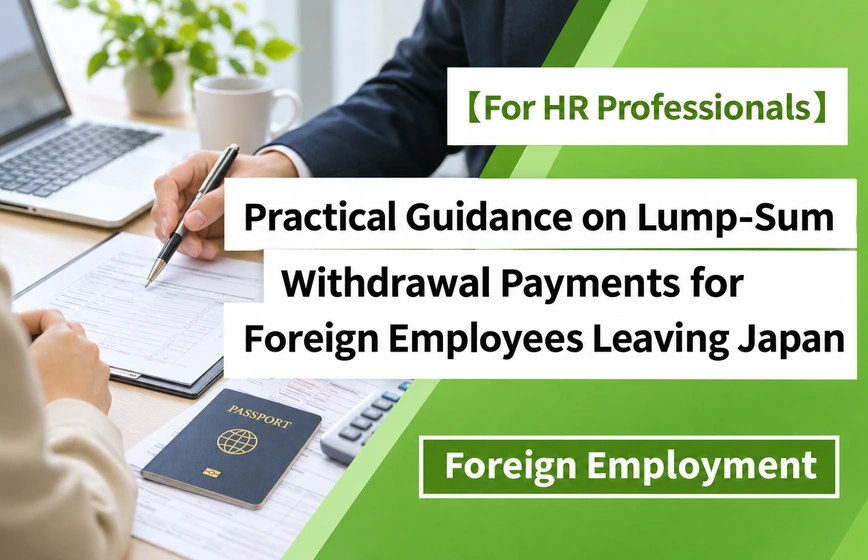
In recent years, more companies in Japan have been hiring employees from a wide range of national backgrounds.
Along with this trend, we frequently receive consultations from HR representatives regarding the procedures required when foreign employees resign and return to their home countries.
When a foreign employee leaves a company, the employer generally completes its initial administrative procedures by submitting the required notifications to terminate the employee’s coverage under social insurance and employment insurance.
However, in practice, consultations increase concerning the procedure for the “Lump-Sum Withdrawal Payment” (脱退一時金 – Dattai Ichijikin), which occurs after the employee leaves Japan.In practice, former employees may contact the company after returning to their home countries with questions such as, “How do I apply for the payment?”, “Why has the payment not arrived?”, or “Can you help me with the tax refund procedures?” These inquiries can create an unexpected administrative burden for HR staff.
In this column, after organizing the labor management issues that easily occur when foreign employees resign and return home, we explain the key points for companies to conduct appropriate procedures and reduce their practical burden. This article explains what HR professionals need to know, including a pre-departure checklist, practical considerations when a company agrees to act as a tax representative in Japan, and the importance of ensuring that outsourced services comply with the Social Insurance and Labor Consultant Act.
まずはお気軽に無料相談・
お問い合わせください!
1.Common HR and Labor Management Issues When Foreign Employees Leave Japan
When a foreign employee resigns and returns to their home country, companies generally recognize that the procedures are completed once they submit the “Notice of Loss of Employment Insurance Qualification” and “Notice of Loss of Social Insurance Qualification.” However, in practice, inquiries frequently arise after the employee has left Japan.
The main cause is a difference in perception regarding the procedures for the “Lump-Sum Withdrawal Payment” (脱退一時金 – Dattai Ichijikin). The Lump-sum Withdrawal Payment system allows eligible non-Japanese nationals who have been covered by Japan’s National Pension or Employees’ Pension Insurance to claim a payment after leaving Japan, provided that they meet the applicable requirements.
These misunderstandings are common in practice.
Some foreign employees perceive that “once I resign and return home, the pension will be automatically transferred” or “the company will act as an agent for everything as part of the retirement procedure.” For this reason, after returning to their home country, realizing that no payment has been made to them,they may contact their former supervisor, an HR representative, or the company’s general inquiry email address to ask about the status of their claim.
Exchanging communications with former employees after their return home creates the following practical burdens:
- Time Difference and Language Barrier: Communication in Japanese may become difficult after returning home, and due to time differences, responding via email takes time.
- Delays Due to Document Deficiencies: There are cases where,an employee may submit a claim directly to the Japan Pension Service, only to have the application returned because of incomplete information or missing or inadequate supporting documents, such as an unclear passport copy or insufficient documentation for the bank account receiving the payment.
- , and they ask the company how to handle it.
Furthermore, if a misunderstanding arises, such as “Is it not paid because the company didn’t do the procedure for me?”, this may undermine the former employee’s trust in the company.
Continuing to respond individually to pension procedures for former employees whose employment relationship has already ended imposes a heavy burden in practice; therefore, it is recommended to proceed smoothly with procedures through advance guidance.
2. How the Lump-sum Withdrawal Payment System Works and Who Is Eligible
In order to guide employees correctly on the Lump-Sum Withdrawal Payment system, it is effective for HR representatives to understand its requirements. Eligible individuals who are not Japanese nationals may claim a Lump-sum Withdrawal Payment within two years from the date on which they no longer have an address in Japan, provided that they are no longer covered by the National Pension or Employees’ Pension Insurance and meet all other eligibility requirements.
For the purpose of calculating the payment amount, the number of months taken into account is generally capped at 60 months (five years), subject to the applicable rules on pension coverage periods.
The main eligibility requirements (in the case of Employees’ Pension Insurance) are as follows:
| Item of Requirement | Content |
|---|---|
| Must not hold Japanese nationality | If naturalized in Japan and Japanese nationality is acquired, the person is exempt. |
| Must not be an insured person under the public pension system | It is required to be in a state of having resigned and lost qualification for Employees’ Pension or National Pension. |
| Total coverage period must be 6 months or more | The applicant must have at least six months of qualifying coverage under the Employees’ Pension Insurance system. |
| Must not have a registered address in Japan | The applicant must no longer have an address in Japan. Filing an overseas moving-out notification with the relevant municipal office is generally part of the process of updating the resident record. |
3. Pre-Departure Checklist for Employers of Foreign Employees
To reduce the burden of post-resignation responses, it is effective for the company to complete basic guidance at the “pre-return” stage while the employee is residing in Japan and direct communication is possible.
Once an employee gives notice of resignation, HR should use the following checklist to provide guidance and confirm the necessary information.
| Checklist Items | Practical Purpose and Confirmation Matters | |
|---|---|---|
| □ | Confirmation of the Basic Pension Number and notification to the employee | The applicant’s Basic Pension Number is required when applying for a Lump-sum Withdrawal Payment. Confirm whether the employee possesses their Pension Handbook or Notice of Basic Pension Number, and advise them to note down the number. |
| □ | Guidance on “Moving-Out Notice (Overseas Transfer)” for Resident Record | To satisfy the payout requirement of “not having an address in Japan,” advise the employee to file an overseas moving-out notification with the relevant municipal office. |
| □ | Confirmation of contact details after returning home | Obtain the email address, etc., after returning home in preparation for cases where confirmation during administrative procedures becomes necessary. |
| □ | Handling of bank accounts in Japan | When conducting tax procedures described later (refund of income tax withheld), keeping a Japanese bank account open may make it easier to receive any tax refund, depending on the applicable procedures. Confirm planned account closures. |
| □ | Advance guidance on the Lump-Sum Withdrawal Payment Claim Form | Inform the employee that multilingual claim forms can be obtained from the Japan Pension Service website, etc., and convey an overview of the procedures. |
When providing this guidance, communicating in advance that “the Lump-Sum Withdrawal Payment procedure is to be conducted by the individual under their own responsibility after returning home” and “the company does not automatically handle the claim on the employee’s behalf” can prevent mutual perception gaps.
4. Guidance for Employees Exempt from the System, Such as Permanent Residents
As a practical point to note, there are cases where guidance is given stating that “Lump-Sum Withdrawal Payments are uniformly paid if you are a foreign employee,” but caution is required. As mentioned above, individuals who fall under certain conditions are exempt from payout.
If incorrect guidance is given to exempt employees, the application may be rejected after returning home, leading to trouble. It is recommended that the company check in advance whether the target person falls under the following statuses:
| Status of Residence and Other Conditions | Eligibility for Payout | Points to Note |
|---|---|---|
| Work Visa (“Engineer/Specialist in Humanities/International Services”, etc.) | Eligible in principle | Eligible if the period of enrollment in Employees’ Pension is 6 months or more and requirements are met. |
| Permanent Resident | Often ineligible | Permanent residents are not automatically excluded from Lump-sum Withdrawal Payments. They may be eligible if they are not Japanese nationals and meet all the other eligibility requirements. However, their eligibility period for an old-age pension must also be checked, including any applicable periods that may be counted toward pension eligibility. |
| Former foreign nationals who have acquired Japanese nationality through naturalization | Ineligible | Exempt if naturalized during employment and Japanese nationality was acquired. |
| Employees with an enrollment period of 10 years or more | Ineligible | If the applicant’s qualifying period for an old-age pension in Japan is 10 years (120 months) or more, they cannot claim a Lump-sum Withdrawal Payment. |
| Applicants with pension coverage periods in countries that have a pension totalization agreement with Japan | Varies depending on conditions | For countries that have concluded a Social Security Agreement with Japan that includes “Totalization of Pension Coverage Periods” (Germany, France, the United States, etc.), receiving the lump-sum payment will render that period unusable for totalization in the future, so it becomes a matter of personal choice. |
HR professionals should check the employee’s status of residence and pension coverage history in advance. and provide guidance tailored to the situation.
5.Key Considerations When a Company Acts as a Tax Representative in Japan
When a foreign employee undertakes the procedure for the Lump-Sum Withdrawal Payment, a matter on which companies are frequently asked to make a decision is accepting the role of “Tax Agent” (納税管理人 – Nōzei Kanriin).
When an Employees’ Pension Insurance Lump-sum Withdrawal Payment is paid, income tax and the Special Income Tax for Reconstruction are withheld at a rate of 20.42% of the payment amount.
Regarding this tax, it is possible to receive a refund by filing a tax return (refund claim) with the tax office after the individual leaves Japan. If the individual wishes to claim a refund after leaving Japan, they may need to appoint a tax representative in Japan to handle the relevant tax procedures and receive tax-related notices on their behalf.
There are cases where resigning employees request, “I want the company to become my Tax Agent and handle the procedures.” When accepting this under the company name or an individual representative’s name, it is necessary to consider in advance that the following practical burdens and points to note will arise:
- Becoming the contact window for Tax Office correspondence:Once appointed as the tax representative, the company may receive tax-related notices concerning the former employee and may need to respond or forward the notices as appropriate.
- Practical burden of overseas remittance:Depending on the applicable refund procedures and the designated payment arrangements, the company may need to assist with transferring the refund to the former employee overseas. Any responsibilities for handling the funds, arranging an international transfer, and covering transfer fees should be agreed upon in advance.
- Man-hours in accounting occur, such as arranging foreign currency transfers and processing transaction fees.
- Discrepancy in perception regarding financial transfers: Due to the burden distribution of remittance fees or exchange rate impacts, if a difference occurs between the amount expected to land in the account by the individual and the actual amount, detailed explanations regarding the breakdown may be requested.
Regarding how far a company supports the tax procedures of an individual whose employment relationship has ended, as these tasks fall outside the company’s usual HR and labor management responsibilities
it is recommended to establish an internal response policy.
6. Ensuring Legal Compliance When Outsourcing Services
In providing guidance or procedural support at the time of resignation, outsourcing operations to external specialists or introducing specialists to employees are options to reduce the company’s practical burden. In doing so, it is important to confirm whether the contractor complies with relevant laws and regulations.
Certain services involving the preparation and submission of pension-related documents on behalf of clients for compensation may be subject to restrictions under Japan’s Social Insurance and Labor Consultant Act. Companies should therefore verify that any external provider is legally authorized to perform the services being outsourced.
. Providing certain services reserved for licensed Social Insurance and Labor Consultants for compensation without the required qualification may violate Japan’s Social Insurance and Labor Consultant Act. The legality of an outsourced service should be assessed based on the specific tasks performed, the applicable statutory provisions, and any relevant exceptions.
7. Summary: Establishing Proper Procedures for Lump-sum Withdrawal Payments
Supporting foreign employees so that they can proceed smoothly with resignation and return procedures is one of the important processes in corporate HR and labor management.
To summarize the key points of this column:
- To reduce the practical burden after resignation, complete necessary procedural guidance while the employee is still employed (before returning home).
- Check each employee’s eligibility for a Lump-sum Withdrawal Payment, including whether they meet the minimum coverage requirements and whether they qualify for an old-age pension in Japan.
- Considering the practical burdens of tax procedures and overseas remittances, establish an internal policy on whether the company will accept the role of “Tax Agent.”
- When outsourcing claim-related services or referring employees for assistance with tax refund applications, choose qualified professionals who are legally authorized to perform the specific services required, such as licensed Social Insurance and Labor Consultants or licensed tax professionals in Japan.
In labor management for foreign employment, procedures at resignation and return home tend to become complex. To resolve questions regarding pensions and taxes that easily arise with former employees in advance and encourage appropriate procedures, please consider correct understanding of the system and utilization of specialists.
Daiichi Sogo Social Insurance and Labor Consultant Corporation provides practical support for Lump-sum Withdrawal Payment procedures related to the departure of foreign employees and helps companies establish effective systems for managing international employment and labor matters.
. If you have any questions regarding responses to employees scheduled to resign, please feel free to contact us.
この記事の監修者
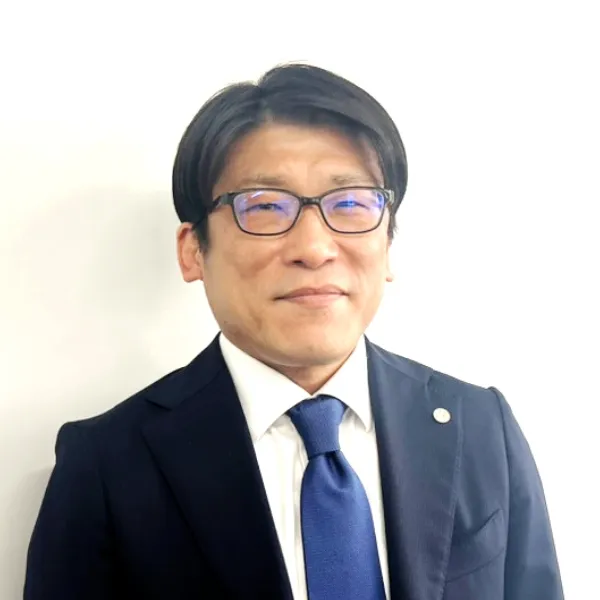
社会保険労務士法人第一綜合事務所
社会保険労務士 菅澤 賛
- 全国社会保険労務士会連合会(登録番号13250145)
- 東京都社会保険労務士会(登録番号1332119)
東京オフィス所属。これまで800社以上の中小企業に対し、業種・規模を問わず労務相談や助成金相談の実績がある。就業規則、賃金設計、固定残業制度の導入支援など幅広く支援し、企業の実務に即したアドバイスを信念とする。